
Occupational Therapy (OT) is one of the more overlooked but genuinely strong study and migration options for Indian students in Australia. It sits on the Medium and Long-Term Strategic Skills List (MLTSSL), carries a "national shortage" flag on the Jobs and Skills Australia Occupation Shortage List, and leads to a registered allied health profession with solid long-term salary growth. This guide covers the two main study pathways — the Bachelor of Occupational Therapy (Honours) and the Master of Occupational Therapy (Graduate Entry) — along with 2026 fees, entry requirements, top universities, and how the qualification connects to Australian permanent residency.
Why Occupational Therapy Is a Smart Choice for Indian Students
Occupational therapists help people regain independence after injury, illness, or disability — work that spans hospitals, rehabilitation centres, disability services, aged care, mental health, and paediatrics. Because it's a registered allied health profession under the Australian Health Practitioner Regulation Agency (AHPRA) and appears on the MLTSSL, it offers Indian graduates two things at once: a genuinely in-demand, well-paid clinical career, and a realistic pathway toward Subclass 189, 190, or 491 skilled visas.
Study Pathways: Bachelor vs Master of Occupational Therapy
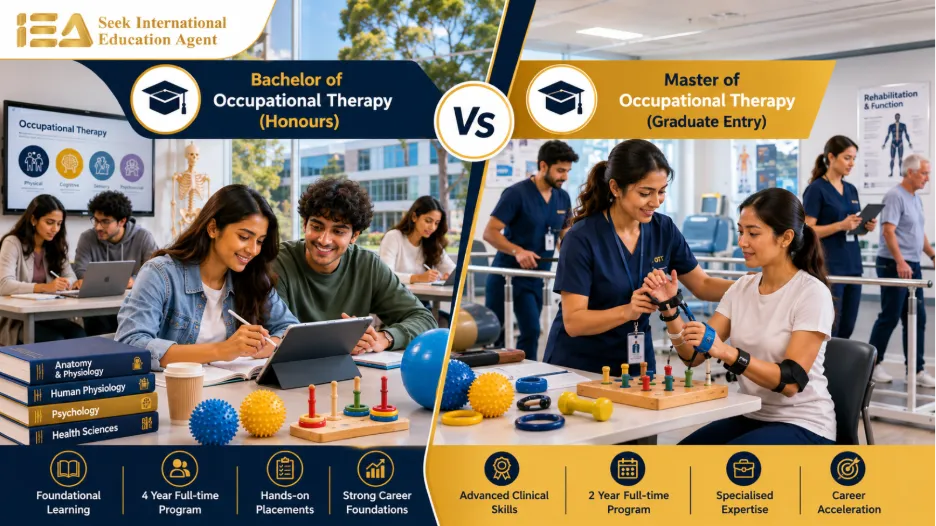
1. Bachelor of Occupational Therapy (Honours)
The standard direct-entry pathway for students coming straight from Year 12 or a relevant diploma.
- Duration: typically 4 years full-time. Some universities (for example, Western Sydney University) do allow students to exit after 3 years with a Bachelor of Health Science — but this exit-point qualification does not make you eligible for AHPRA registration as an OT; you need to complete the full 4-year Honours program for that.
- Structure: combines classroom study, simulated clinical labs, and supervised fieldwork placements across health and community settings
- Best for: school leavers or students without a prior bachelor's degree
2. Master of Occupational Therapy (Graduate Entry)
Designed for students who already hold a bachelor's degree and want to fast-track into OT practice. This pathway is not restricted to psychology or health science graduates specifically — but your degree field still matters in practice, in two ways:
- Duration: typically 2 years full-time
- Prerequisites (apply regardless of your degree field): most universities require completed prior coursework in human anatomy (including musculoskeletal and systems anatomy) and research methodologies at minimum, generally completed within the last 10 years; some also require behavioural science or psychology units. If your bachelor's degree — for example, in business, commerce, or another unrelated field — didn't include these subjects, you'll typically need to complete them separately as bridging or prerequisite units before you can start, which adds time and cost.
- University-specific degree requirements: some universities accept a bachelor's degree in any discipline provided you meet the prerequisite subjects above, but others (for example, Bond University) specifically require your bachelor's degree to be in a health-related field, which rules out direct entry for business or unrelated-degree holders regardless of bridging study. Always check this university-by-university — don't assume a business degree automatically qualifies you everywhere.
- Best for: graduates pivoting into allied health, particularly from a related undergraduate degree, though genuinely open to other backgrounds at the right university with the right prerequisites completed
Both pathways lead to eligibility for registration as an Occupational Therapist with AHPRA and are accredited against the same national competency standards, so the choice mostly comes down to your current academic background, budget, and how quickly you want to enter the workforce.
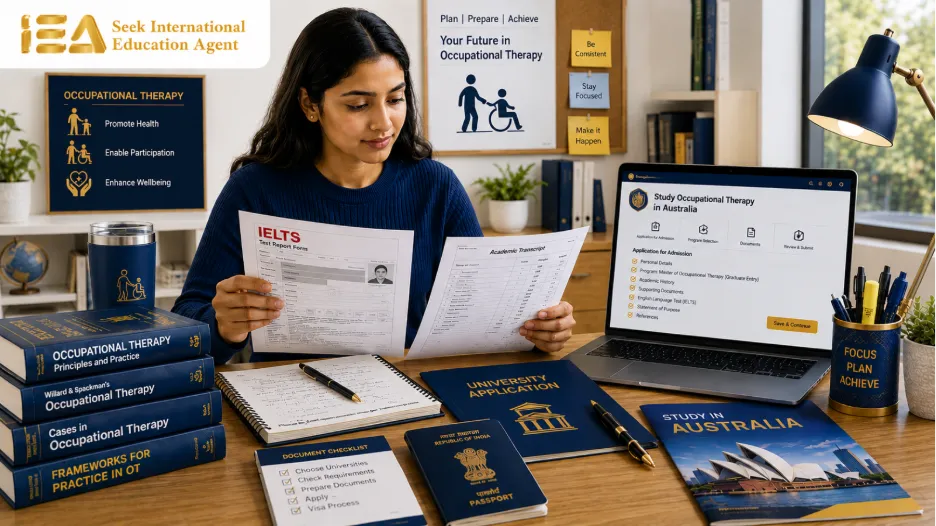
Entry Requirements
| Requirement | Bachelor of Occupational Therapy (Honours) | Master of Occupational Therapy (Graduate Entry) |
|---|---|---|
| Academic | Year 12 completion (or equivalent) | Completed bachelor's degree, plus required prerequisite subjects (varies by university) |
| English (IELTS Academic) | Overall 7.0, with 7.0 in Reading, Listening and Speaking, and 6.5 in Writing (or equivalent) | Same |
| Alternative English tests | PTE Academic or TOEFL iBT accepted by most universities | Same |
| Other | Working with children/vulnerable people checks and immunisation compliance typically required before clinical placements | Same |
These figures reflect the Occupational Therapy Board of Australia's registration standard, revised effective 18 March 2025, which reduced the required Writing band from 7.0 to 6.5 while keeping Reading, Listening and Speaking at 7.0.
Top Universities Offering Occupational Therapy in Australia
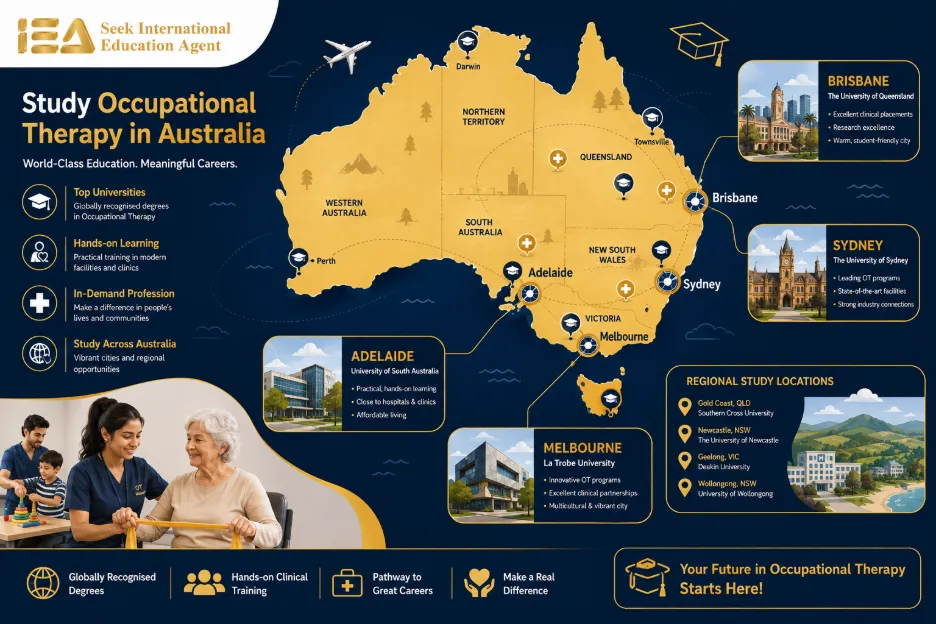
| University | Programs Offered | Notable For |
|---|---|---|
| University of Queensland | Bachelor of Occupational Therapy (Honours) | Strong clinical placement network in Queensland |
| University of Adelaide | Bachelor of OT (Honours), Master of OT (Graduate Entry) | Well-established allied health faculty |
| Western Sydney University | Bachelor of Occupational Therapy | Large NSW placement network |
| Southern Cross University | Bachelor of Occupational Therapy | Regional NSW clinical exposure |
| Flinders University | Master of Occupational Therapy | Competitive fees, South Australia based |
| Swinburne University | Master of Occupational Therapy | Melbourne-based, strong industry links |
| University of South Australia | Occupational Therapy programs | Established simulation facilities |
Roughly two dozen Australian universities offer OT qualifications in some form, so shortlist based on placement locations, fees, and course structure rather than name recognition alone. Course availability and intake dates change each year, so always confirm current offerings directly on the university's course page before applying.
Fees & Cost of Studying Occupational Therapy (2026)

- International tuition fees: generally sit in the AUD 55,000–90,000 range for the full course
- Flinders University's Master of Occupational Therapy: approximately AUD 49,700 per year
- General first-year indicative fees: around AUD 55,000–62,000 for many providers
- Overseas Student Health Cover (OSHC): approximately AUD 500–700 per year, mandatory for all international students
As with nursing, exact fees vary meaningfully by university and change annually, so always confirm current published fees directly with your shortlisted universities before budgeting.
AHPRA Registration
On completing an accredited Bachelor or Master of Occupational Therapy program, graduates become eligible to register with the Occupational Therapy Board of Australia via AHPRA. Registration requires meeting AHPRA's English language skills standard and providing evidence of your accredited qualification — most universities guide graduating students through this process directly.
Career Outlook & Salary for Occupational Therapists in Australia
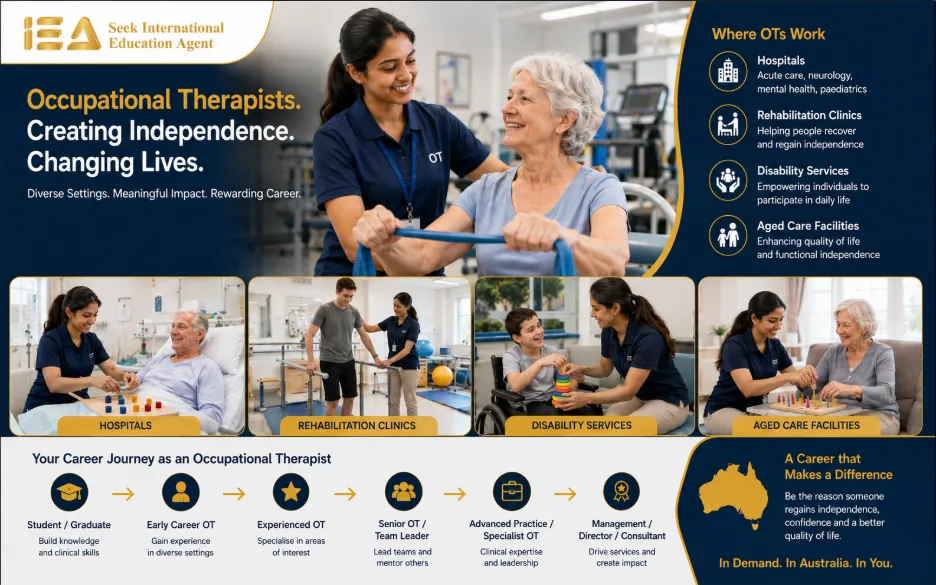
Reported salary figures vary by source and experience level, but converge broadly as follows:
- New graduates: around AUD 74,000–80,000
- Average base salary: roughly AUD 95,000–105,000 (excluding the standard 11.5% superannuation)
- Senior OTs in acute care or private practice: AUD 97,000–125,000+, depending on state and specialisation
Demand spans public hospitals, private allied health clinics, the National Disability Insurance Scheme (NDIS) sector, aged care, and paediatric services — the breadth of settings is one reason OT shortages persist across both metro and regional Australia.
PR & Visa Pathways for Occupational Therapists
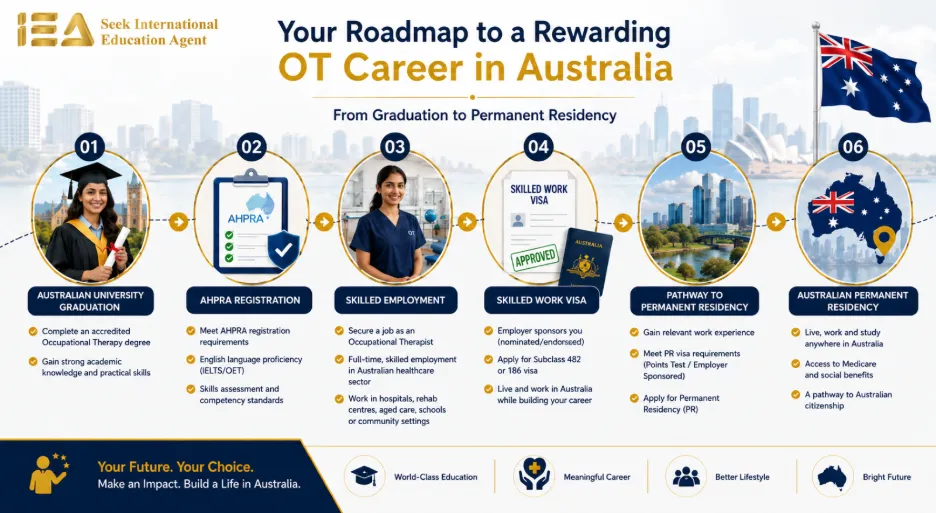
Occupational Therapist appears on the MLTSSL, alongside other allied health roles such as physiotherapists, radiographers and speech pathologists, all currently flagged as being in national shortage. This status supports eligibility for:
- Subclass 189 (Skilled Independent)
- Subclass 190 (Skilled Nominated, with state/territory nomination)
- Subclass 491 (Skilled Work Regional)
As with all MLTSSL occupations, invitation rounds are points-tested and competitive, so building your points profile — through regional study, English proficiency, or partner skills — improves your chances alongside simply holding the qualification.
How to Apply: Step by Step
- Choose your pathway — Bachelor of OT (Honours) if you're a school leaver, Master of OT (Graduate Entry) if you already hold a relevant bachelor's degree.
- Check university-specific prerequisites, especially for the graduate-entry master's.
- Meet English language requirements (IELTS 7.0 overall, with 7.0 in Listening, Reading and Speaking and 6.5 in Writing, or equivalent).
- Apply with transcripts, English scores, and any required prerequisite evidence.
- Accept your offer, pay the deposit, and receive your Confirmation of Enrolment (CoE).
- Apply for your Subclass 500 student visa.
- Arrange OSHC before you travel to Australia.
Scholarships & Financial Support for OT Students
- Australia Awards Scholarships: DFAT-funded, with India as a priority country; covers tuition, travel and living costs for eligible postgraduate applicants in fields including allied health. Applications typically open in February and close in late April for the following year's intake.
- University merit scholarships: universities such as Western Sydney University and Flinders University publish their own international student scholarships covering partial tuition; check each institution's current offerings, as they change annually.
- Destination Australia Program: relevant if you choose a regional campus or placement location.
- Maitri Scholars Program: supports outstanding Indian students pursuing postgraduate study in Australia, with a preference for STEM-related fields.
Most scholarships require a strong academic record (commonly 65%+) and IELTS 6.5–7.0 or equivalent, so keep documentation current when applying.
Cost of Living for OT Students in Australia
Beyond tuition, the Australian Government's official minimum living cost requirement for a student visa is AUD 29,710 per year for a single student — this is the figure the Department of Home Affairs uses to assess financial capacity. Actual costs may run higher in Sydney and Melbourne and somewhat lower in regional cities, but budget against the official AUD 29,710 figure as your baseline. Because OT fieldwork placements can be located outside your home city, budget for potential temporary relocation or commuting costs during placement blocks.
Common Mistakes Indian OT Applicants Make
- Assuming all "Master of Occupational Therapy" programs have the same entry requirements — prerequisite subjects (anatomy, physiology, psychology) vary significantly between universities, so check each one individually.
- Relying on outdated English requirement information — the Occupational Therapy Board of Australia revised its English standard effective 18 March 2025, reducing the required Writing band from 7.0 to 6.5 (Listening, Reading and Speaking remain at 7.0). Older sources may still quote the previous "7.0 across all bands" rule, so confirm the current standard on the Board's official website.
- Not planning placement logistics early — fieldwork blocks can require travel or temporary accommodation away from your primary campus.
- Overlooking the NDIS sector as a career destination — it's one of the largest employers of OTs in Australia and worth researching alongside hospital and private practice roles.
Frequently Asked Questions
Yes. Indian students can study Occupational Therapy in Australia through accredited bachelor's or master's programs after meeting the academic and English language requirements.
A Bachelor of Occupational Therapy usually takes four years, while a graduate-entry Master of Occupational Therapy typically takes two years.
Students generally need the required academic qualifications, English language proficiency and any university-specific prerequisite subjects.
International tuition fees generally range from AUD 55,000 to AUD 90,000 for the full course, depending on the university. Students must also budget for health insurance and accommodation.
Yes. To practise as an Occupational Therapist in Australia, one needs to be registered with the Australian Health Practitioner Regulation Agency (AHPRA) after successfully completing an accredited Occupational Therapy course.
Yes. Occupational Therapist is listed on Australia's Medium and Long-Term Strategic Skills List (MLTSSL), making it a suitable occupation for immigration purposes, with various skilled migration visa options.
A wide range of universities provide accredited Occupational Therapy courses, including the University of Queensland, University of Adelaide, Flinders University, Western Sydney University, Swinburne University, and the University of South Australia.
Yes. A number of scholarship opportunities are available to eligible international students, such as the Australia Awards Scholarships, university-specific merit-based scholarships, and the Destination Australia Program, depending on the particular university and course.