

Nursing consistently ranks among the most popular courses in Australia for Indian students, and for good reason. Registered Nurse remains on Australia's Medium and Long-term Strategic Skills List (MLTSSL), the country's ageing population is driving sustained hiring, and the profession offers a clear route from a student visa to permanent residency. But "study nursing in Australia" isn't a single decision — Indian students typically choose between three distinct pathways: the Bachelor of Nursing (BN), the Master of Nursing (Graduate Entry), and the Bachelor of Nursing (Graduate Entry) — a lesser-known but genuinely useful third option for non-nursing graduates, offered at universities such as Flinders. This guide breaks down each pathway, current 2026 fees, entry requirements, top universities, and the registration and migration process, based on information verified across university admissions pages and independent migration sources.
Why Study Nursing in Australia
Australia's healthcare system is under sustained pressure from an ageing population and workforce shortages, which is why Registered Nurse (ANZSCO 254499) has remained on the MLTSSL for several consecutive skilled migration cycles. For Indian students this translates into three practical advantages: a globally respected nursing qualification accredited by the Australian Nursing and Midwifery Accreditation Council (ANMAC), strong graduate employment rates, and one of the more reliable pathways to permanent residency through the Subclass 189 (Skilled Independent) and 190 (State Nominated) visas.
Three Nursing Pathways for Indian Students
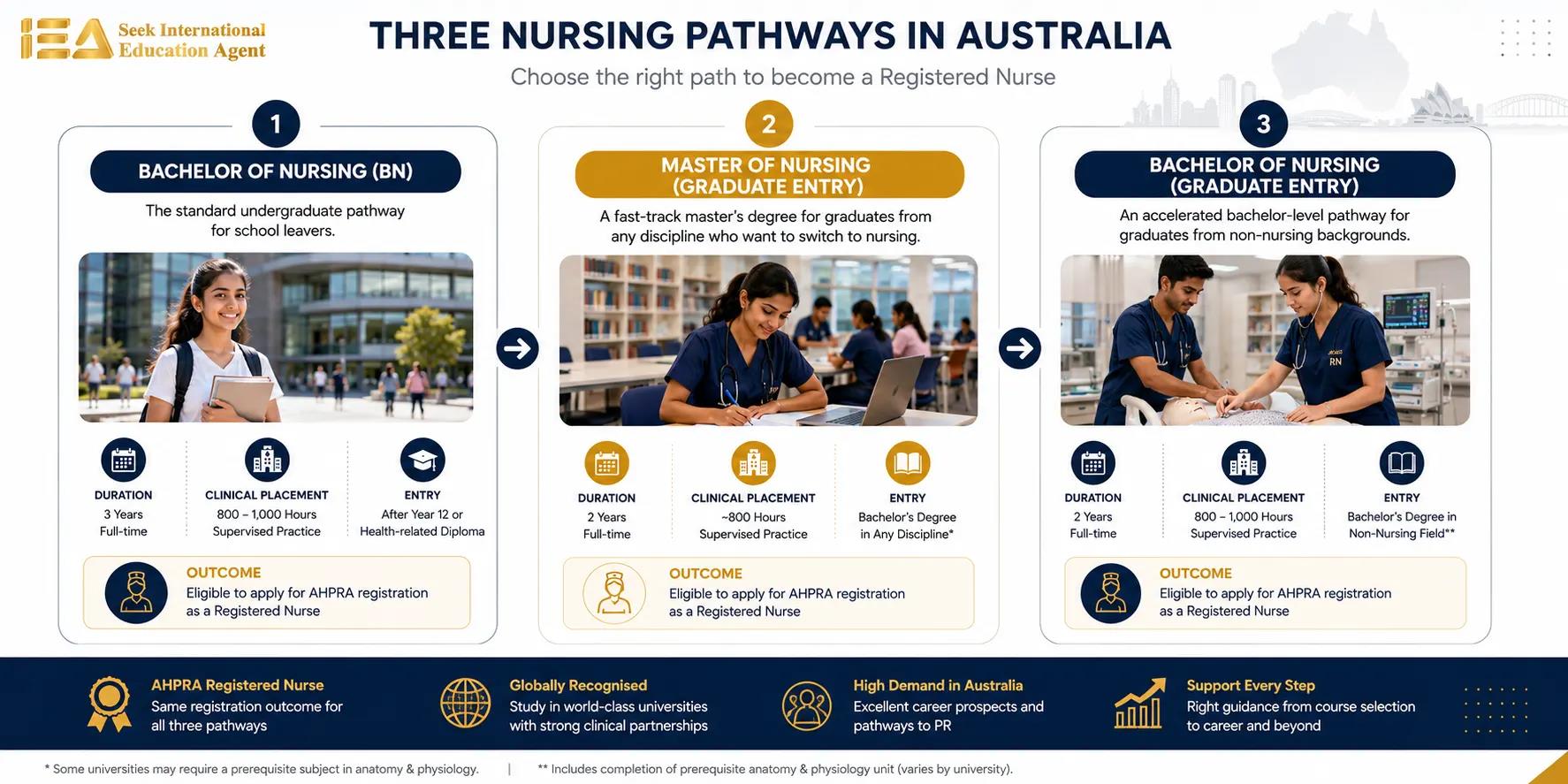
1. Bachelor of Nursing (BN)
The standard entry point for students straight out of Year 12 or with a relevant diploma. It's a three-year, full-time undergraduate degree that qualifies graduates to register as a Registered Nurse with AHPRA (the Australian Health Practitioner Regulation Agency) on completion.
- Duration: 3 years full-time
- Clinical placement: 800–1,000 hours of supervised clinical practice across hospitals and health services, built into the course
- Best for: students entering directly from secondary school or with a health-related diploma
2. Master of Nursing (Graduate Entry)
This is the pathway for students who already hold a bachelor's degree in any discipline (not necessarily health-related) and want to become a Registered Nurse. It compresses entry-to-practice nursing education into a two-year, intensive master's degree, including roughly 800 hours of clinical placement, and leads to the same AHPRA registration as the BN.
- Duration: 2 years full-time
- Entry: bachelor's degree in any field, plus English language requirements. Note that some universities also require completion of a prerequisite subject covering human anatomy and physiology before you start — this varies by institution, so check the specific course requirements rather than assuming "any discipline" means no prerequisites at all.
- Best for: graduates who want to switch careers into nursing without repeating a full undergraduate degree; it can also work out cheaper overall than a BN once you factor in one less year of living costs
3. Bachelor of Nursing (Graduate Entry)
A genuinely distinct third pathway, offered by a smaller number of universities — Flinders University is a well-known example. This is a bachelor-level (not master's) accelerated degree specifically for students who already hold a bachelor's degree in a field other than nursing, and it leads directly to AHPRA registration as a Registered Nurse on completion, the same as the standard BN and the Master of Nursing (Graduate Entry).
- Duration: 2 years full-time (at Flinders University)
- Entry: a completed bachelor's degree in a field that does not already qualify you for NMBA registration, plus successful completion of a prerequisite unit covering human body structure and function (anatomy and physiology) — at Flinders, this is 4.5 units (1 topic) of relevant prior study
- AHPRA registration: Yes — graduates are eligible to apply for registration with the Nursing and Midwifery Board of Australia, the same outcome as the BN and Master of Nursing (Graduate Entry)
- Study locations: at Flinders, available at the metropolitan Bedford Park campus or the rural Riverland campus
- Best for: graduates who want a genuine fast-track into nursing but prefer (or whose target university only offers) a bachelor-level accelerated award rather than a master's-level one
Because the "Bachelor of Nursing (Graduate Entry)" and "Master of Nursing (Graduate Entry)" serve a similar purpose — a fast-track for non-nursing graduates — but differ in award level, prerequisites, and fees, it's worth comparing both directly at your shortlisted universities rather than assuming they're interchangeable.
Entry Requirements
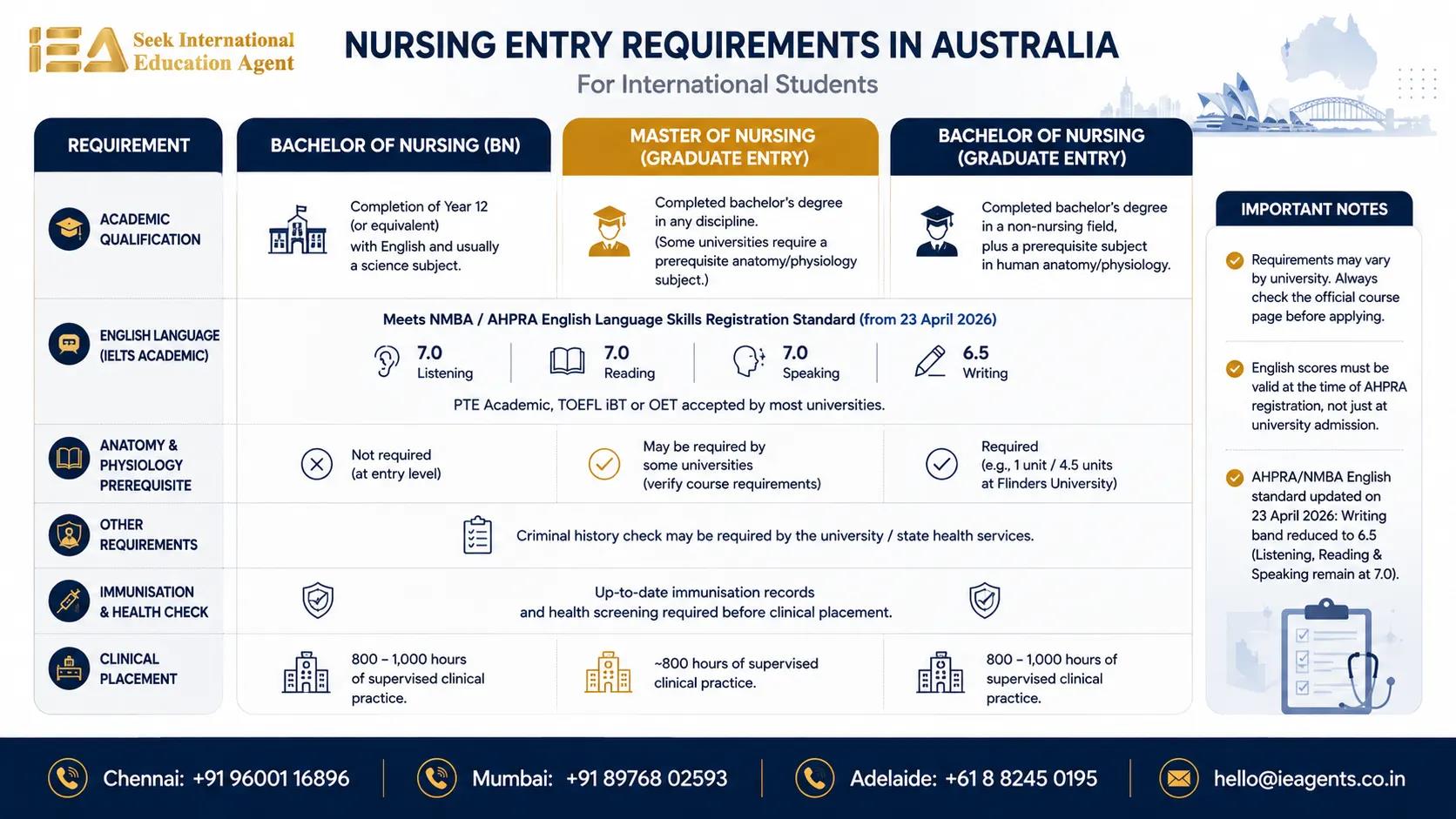
| Requirement | Bachelor of Nursing | Master of Nursing (Graduate Entry) | Bachelor of Nursing (Graduate Entry) |
|---|---|---|---|
| Academic | Year 12 completion (or equivalent), often with English and a science subject | Completed bachelor's degree in any discipline (some universities also require a prerequisite anatomy/physiology subject) | Completed bachelor's degree in a non-nursing field, plus a prerequisite subject in human anatomy/physiology |
| English (IELTS Academic) | Overall 7.0, with 7.0 in Listening, Reading and Speaking, and 6.5 in Writing (or equivalent) | Same | Same |
| Alternative English tests | PTE Academic, TOEFL iBT, or OET accepted by most universities | Same | Same |
| Other | Some universities require a criminal history check and immunisation records for clinical placement | Same | Same |
These figures reflect the Nursing and Midwifery Board of Australia's (NMBA) revised English language skills registration standard, which took effect from 23 April 2026 and reduced the required Writing band from 7.0 to 6.5 while keeping Listening, Reading and Speaking at 7.0. This is the benchmark most universities align their own admission requirements to, though it's always worth confirming the exact current score directly with both AHPRA/NMBA and your shortlisted university, as standards are reviewed periodically.
Top Universities Offering Nursing in Australia
| University | Programs Offered | Notable For |
|---|---|---|
| University of Melbourne | Master of Nursing (Graduate Entry) | Highly ranked, strong clinical partnerships |
| University of Sydney | Bachelor of Nursing, Master of Nursing | Large teaching hospital network |
| University of New South Wales (UNSW) | Bachelor of Nursing | Strong research and clinical training |
| Deakin University | Bachelor of Nursing, Master of Nursing | Purpose-built simulation clinical labs |
| Griffith University | Bachelor of Nursing, Master of Nursing (Graduate Entry) | Well regarded in Queensland |
| Edith Cowan University (ECU) | Master of Nursing (Graduate Entry) | Competitive fees, Perth-based clinical placements |
| Southern Cross University (SCU) | Master of Nursing (Graduate Entry) | Regional NSW placements |
| Flinders University | Bachelor of Nursing (Graduate Entry), Bachelor of Nursing (Pre-registration) | One of the few universities offering the bachelor-level graduate-entry pathway; metropolitan (Bedford Park) or rural (Riverland) campus options |
Course availability and intake dates change each year, so always confirm current offerings directly on the university's course page before applying.
Fees & Cost of Studying Nursing in Australia (2026)
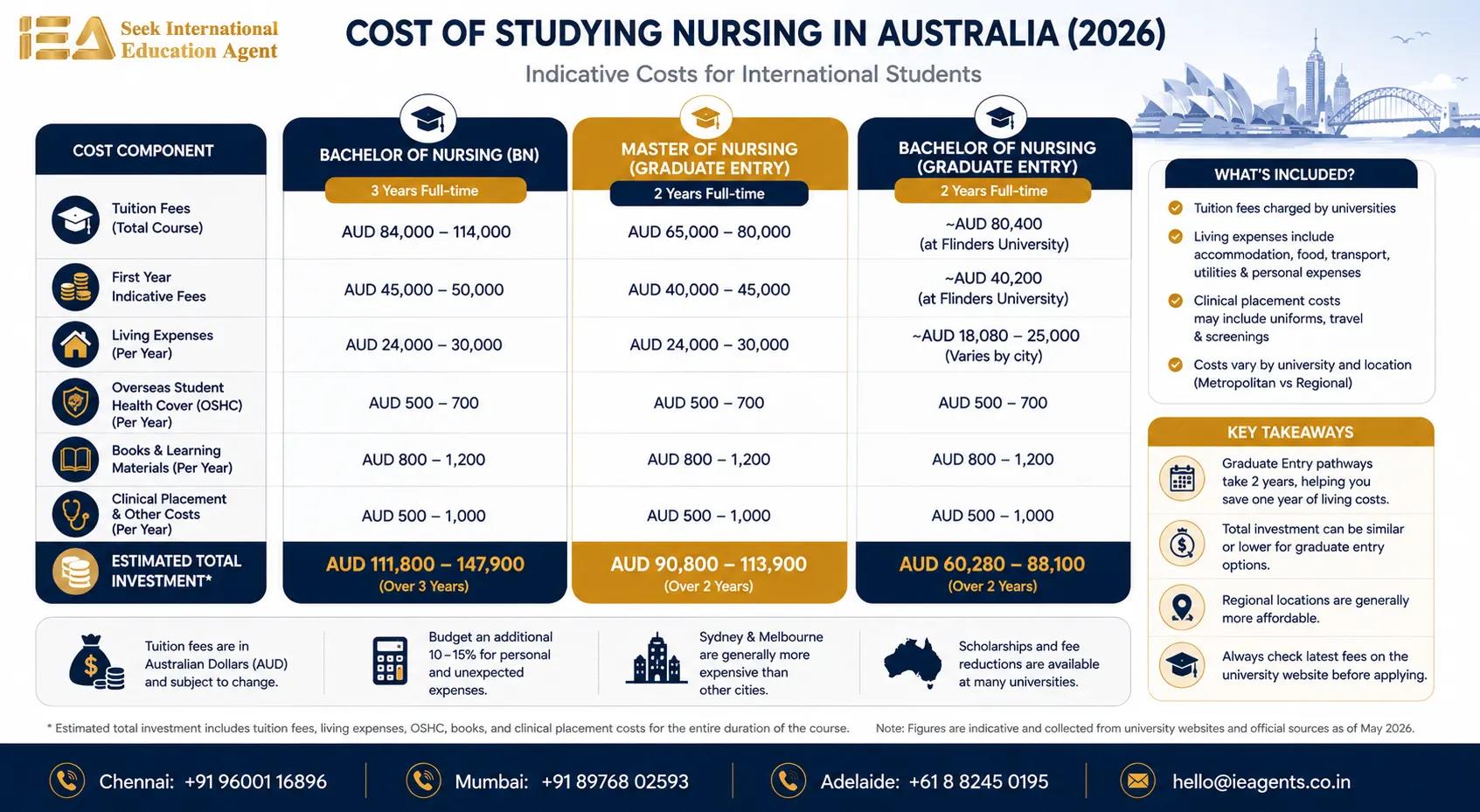
- Bachelor of Nursing: total course fees of roughly AUD 84,000–114,000 over three years, with first-year fees typically around AUD 45,000–50,000, depending on the university.
- Master of Nursing (Graduate Entry): total fees generally range from AUD 65,000–80,000 over two years; first-year indicative fees at some universities sit around AUD 45,000.
- Bachelor of Nursing (Graduate Entry): at Flinders University, the first-year indicative fee is approximately AUD 40,200, with estimated living costs around AUD 18,080 per year — broadly comparable to, or slightly below, the Master of Nursing (Graduate Entry) fee range.
- Overseas Student Health Cover (OSHC): approximately AUD 500–700 per year, mandatory for all international students.
Because the master's pathway is one year shorter than the bachelor's, the total investment (tuition plus living costs) can end up comparable or even lower than the BN, despite the higher per-year tuition — worth modelling out based on your own budget and the city you plan to study in.
AHPRA Registration: What Happens After You Graduate
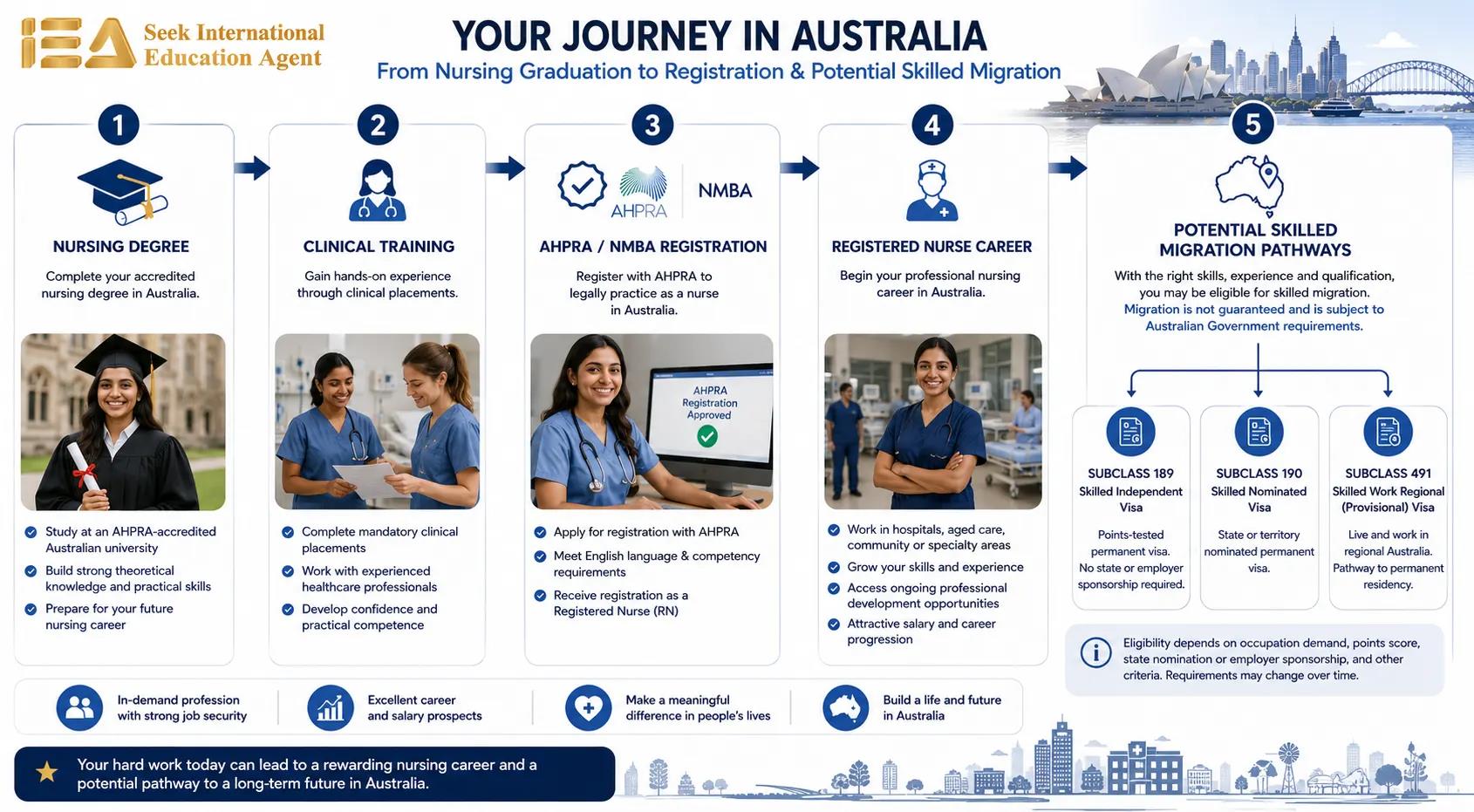
On completing an accredited BN or Master of Nursing (Graduate Entry) program, universities forward your details to AHPRA for registration with the Nursing and Midwifery Board of Australia — there's no separate registration fee for this initial step beyond AHPRA's standard registration charge. You'll need to meet AHPRA's English language and criminal history requirements at the point of registration, not just at university admission, so keep your test scores and documentation current through to graduation.
Career Outlook & Salary for Nurses in Australia
Registered Nurse salaries in Australia vary by source, sector and seniority, but converge broadly around:
- Entry-level to average RN salary: roughly AUD 65,000–95,000 per year, with a commonly cited median around AUD 86,500
- Advertised average (Seek 2026 Healthcare Salary Report): approximately AUD 82,500 per year, with senior/specialist roles reaching AUD 95,000–110,000+
- Superannuation: an additional 11.5–12% employer contribution on top of salary
Aged care, hospital, and community health settings all report ongoing demand, and rural and regional placements often carry additional incentives — worth exploring if you're open to working outside a capital city, since it can also strengthen a state nomination (subclass 190) application.
PR & Visa Pathways for Nurses
Registered Nurse (254499) has featured on the MLTSSL across recent skilled migration cycles, making it eligible for:
- Subclass 189 (Skilled Independent) — points-tested, no state or employer sponsorship required
- Subclass 190 (Skilled Nominated) — requires state/territory nomination, adds points
- Subclass 491 (Skilled Work Regional) — for regional nomination, often has lower point thresholds
Competition for invitations has increased, with many successful 2026 applicants reporting points scores in the 85–90 range, so building points early — through regional study, partner skills, or additional qualifications — matters. Your Australian nursing qualification is assessed by ANMAC as the relevant skills assessing authority for migration purposes.
How to Apply: Step by Step
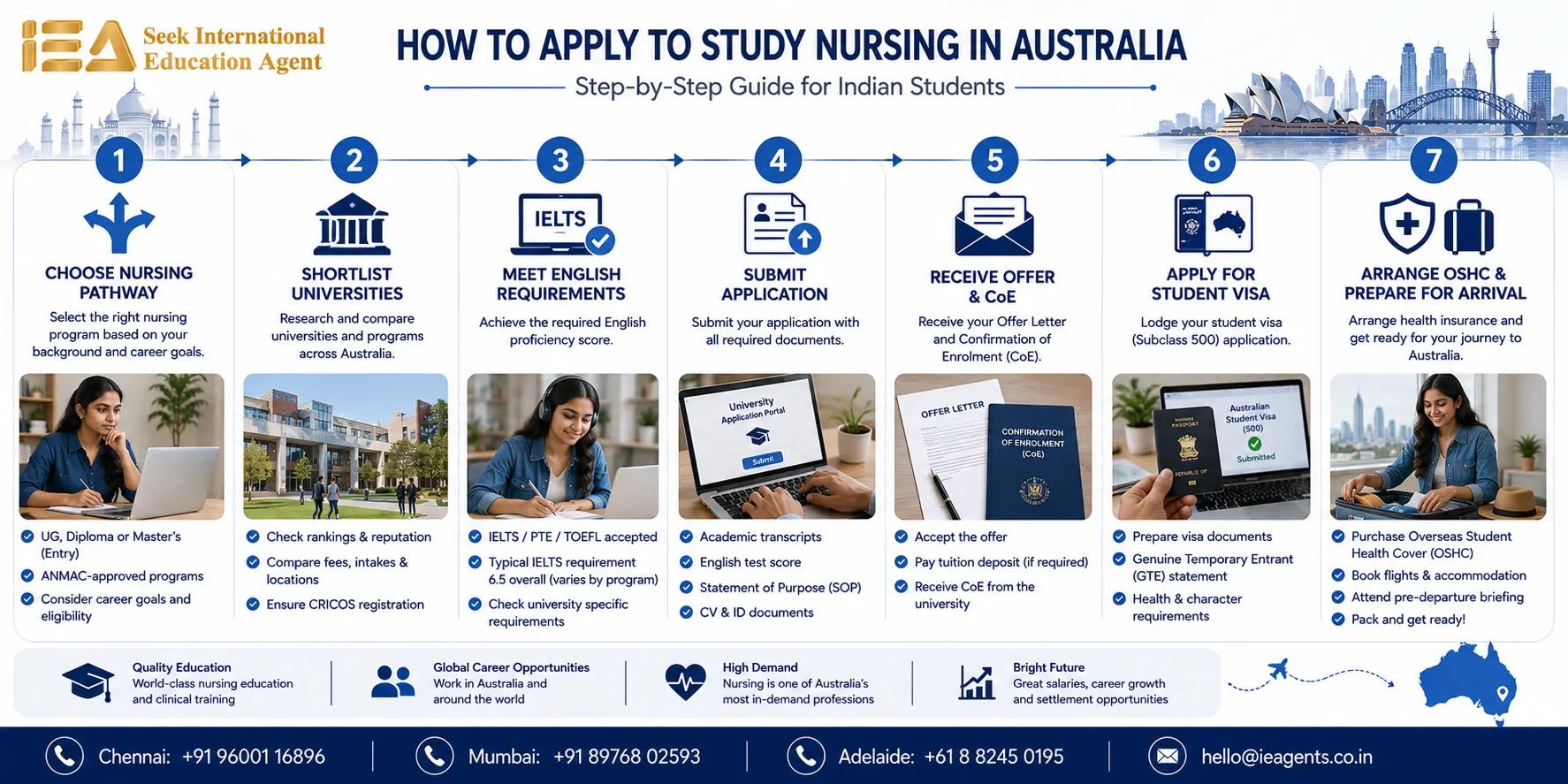
- Decide which pathway fits your background — the BN if you're a recent Year 12 graduate, or the Master of Nursing (Graduate Entry) or Bachelor of Nursing (Graduate Entry) if you already hold a bachelor's degree in another field.
- Shortlist universities based on location, fees, and clinical placement network.
- Meet English language requirements (IELTS 7.0 overall, with 7.0 in Listening, Reading and Speaking and 6.5 in Writing, or equivalent).
- Submit your application with academic transcripts, English test scores, and a statement of purpose.
- Accept your offer and pay the required deposit to receive your Confirmation of Enrolment (CoE).
- Apply for your Australian student visa (Subclass 500).
- Arrange Overseas Student Health Cover (OSHC) before departure.
Scholarships & Financial Support for Indian Nursing Students
Nursing tuition is a significant investment, but several funding options can reduce the burden:
- Australia Awards Scholarships: the Australian Government's flagship scholarship program (funded by DFAT), with India as a priority country; covers tuition, travel and living costs for eligible postgraduate applicants, including some health-related fields. Applications typically open in February and close in late April for the following year's intake, so plan well ahead.
- University merit scholarships: many universities offering nursing — including Deakin, Griffith, and ECU — publish their own partial-fee-reduction scholarships for high-achieving international students; check each university's international scholarships page directly, as offerings change yearly.
- Destination Australia Program: supports students studying at regional campuses, which can be relevant if you choose a regional nursing placement location.
- State-specific health workforce incentives: some states offer relocation or bonded-service incentives for nurses willing to work in regional or rural areas after graduation — worth researching if you're open to working outside a capital city.
Eligibility for most scholarships requires a strong academic record (commonly 65%+) and IELTS 6.5–7.0 or equivalent, so keep your documentation and test scores current when applying.
Cost of Living for Nursing Students in Australia
Beyond tuition, budget for living expenses, which the Australian Government estimates at roughly AUD 24,000–30,000 per year for a single international student, varying by city (Sydney and Melbourne tend to sit at the higher end, while regional cities are typically more affordable). Clinical placement blocks can also mean temporary relocation costs if your placement is outside your home city, so factor this into your budget when choosing a university.
Common Mistakes Indian Nursing Applicants Make
- Confusing the Master of Nursing (Graduate Entry) with the post-registration Master of Nursing — always confirm which one a university is advertising before applying, since entry requirements differ substantially.
- Relying on outdated English requirement information — AHPRA and the Nursing and Midwifery Board of Australia updated the registration standard on 23 April 2026, reducing the required Writing band from 7.0 to 6.5 (Listening, Reading and Speaking remain at 7.0). Older blogs and forum posts may still quote the previous "7.0 across all bands" rule, so always confirm the current standard on the NMBA's official website before relying on it.
- Leaving visa and CoE applications too late — processing times fluctuate, and clinical placement scheduling means late enrolment can push your start date back a full intake.
- Not researching regional placement or work opportunities early — regional experience can meaningfully strengthen a state nomination (Subclass 190/491) application later.
Frequently Asked Questions
Yes — the Master of Nursing (Graduate Entry) is specifically designed for graduates from any discipline; you don't need a prior nursing or science background.
Registered Nurse remains on the MLTSSL, but invitation rounds are competitive. It's still one of the more consistent pathways, though a strong points score is increasingly important.
Generally no — this pathway is designed for career-changers without prior nursing experience, though some universities may look favourably on relevant volunteering or healthcare exposure.
Both are designed for graduates who already hold a bachelor's degree in a non-nursing field and both lead to AHPRA registration as a Registered Nurse. The main differences are the award level (bachelor's vs master's), the specific prerequisite subjects required (the Bachelor of Nursing Graduate Entry at Flinders requires a prior anatomy/physiology unit), and fees, which vary by university — compare both directly rather than assuming they're equivalent.
Tuition fees vary by university and course. A Bachelor of Nursing can cost approximately AUD 84,000–114,000 for the full three years, while a Master of Nursing (Graduate Entry) generally costs around AUD 65,000–80,000 for two years. Students should also budget for living expenses, Overseas Student Health Cover (OSHC), textbooks, uniforms and clinical placement-related costs.
Most Australian nursing programs require strong English proficiency because nursing registration has specific language standards. The current NMBA standard requires IELTS Academic scores of 7.0 in Listening, Reading and Speaking and 6.5 in Writing, or an accepted equivalent. Individual universities may have additional or slightly different admission requirements, so students should check the course page before applying.
After completing an approved nursing program, graduates can apply for registration as a Registered Nurse with the Nursing and Midwifery Board of Australia through AHPRA, provided they meet the relevant registration requirements. Once registered, graduates can pursue nursing roles in hospitals, aged care, community health and other healthcare settings. Those considering skilled migration must separately meet the requirements of the relevant visa pathway.